
Why “Always-On” Devices Matter for Privacy and Surveillance
Bluetooth tracking is one of the quietest forms of modern surveillance. It’s passive, widespread, largely invisible, no hacking is required, no spyware needs to be installed, and no accounts need to be accessed. In many cases, you don’t even have to *use* your device for it to be tracked. If Bluetooth is enabled, your devices may be broadcasting far more about your presence and movement than you realize.
Bluetooth signals can reveal that a device is nearby, what type of device it is, who made it, and its approximate distance. With enough data points, that distance can even be triangulated. Some Bluetooth signals include persistent or semi-persistent identifiers, while others can still be linked together through timing and behavior patterns. The key issue is this: Bluetooth devices advertise themselves even when you are not actively using them. Most people carry more than one such device.
The Rise of “Always-On” Bluetooth Devices
Bluetooth-enabled devices now include smartphones, smartwatches, laptops, tablets, wireless earbuds, fitness trackers, medical devices, AirTags and Tile trackers, car infotainment systems, key fobs, and smart keys. Many of these devices are designed to be always ready, always available, and always listening.
Individually, a single device may not say much. Together, they form a Bluetooth constellation, a cluster of devices that move together in consistent patterns. That constellation can be used to identify not just the devices themselves, but the person(s) carrying them.
This is why Bluetooth tracking is increasingly relevant to investigators, journalists, activists, and anyone concerned with personal privacy or physical security.
Two Ways Bluetooth Tracking Happens
1. Phone App–Based Bluetooth Tracking
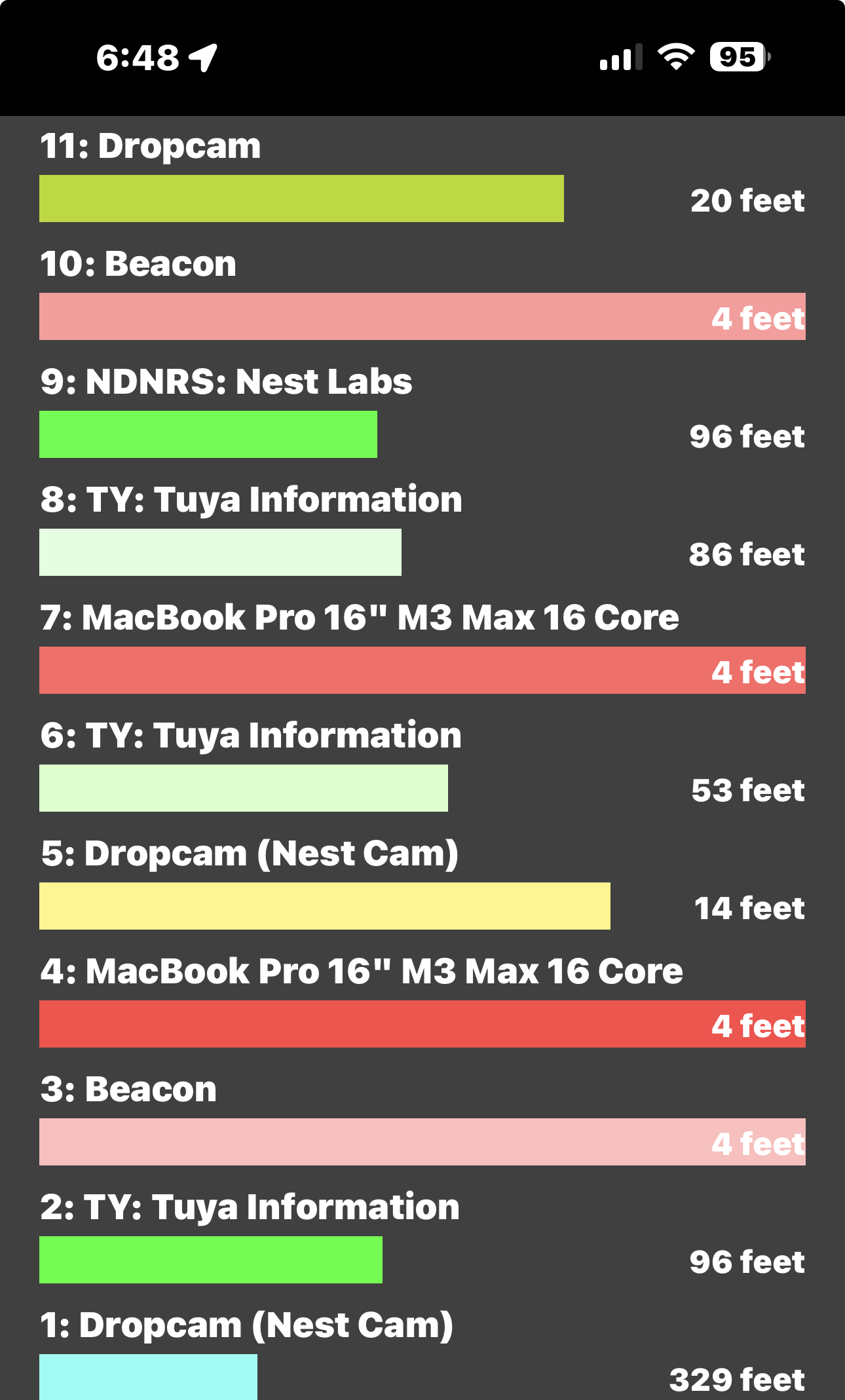
BlueHound on iOS
Most people don’t need specialized hardware to explore Bluetooth exposure. Smartphones already have powerful Bluetooth radios, and a wide range of free apps make scanning easy and accessible to the public. These apps can detect nearby Bluetooth devices, estimate distance using signal strength, and sometimes log or map devices over time. Some even rely on crowdsourced data to indicate where devices have been previously seen.
There are limitations. Operating systems often restrict access to certain identifiers, such as MAC addresses, especially on Apple devices. Even so, these apps can scan continuously, track multiple devices at once, and operate silently in the background.
Common examples include:
nRF Connect
LightBlue
Bluepixel Bluetooth Scanner
WiGLE Bluetooth
BlueHound
These tools are easy to use, widely available, and often free.
2. Hardware-Based Bluetooth Tracking
Dedicated Bluetooth monitoring tools take things further. Small USB-connected devices, such as Ubertooth, listen directly to Bluetooth radio signals. Because they operate at the radio level, they bypass many of the privacy and safety restrictions enforced by operating systems.
These devices:
Passively observe Bluetooth traffic
Remain undetectable to the devices being tracked
Capture raw signal data
Excel at identifying patterns over time
While often described as research tools, they are surprisingly accessible. They require no programming knowledge, though some comfort with command-line tools is helpful. Prices typically range from about $40 to $150, and hobbyists can even build them from scratch.
This makes hardware-based Bluetooth tracking portable, discreet, and easy to deploy.
Why Bluetooth Privacy Is a Serious Issue (and an Opportunity)
Bluetooth tracking is passive, silent, legal in many jurisdictions, and highly effective. It is also difficult to detect without deliberately looking for it. Even when devices rotate their MAC addresses, they can still be recognized through signal timing, behavior patterns, and correlated movement. When multiple devices move together, such as a phone, smartwatch, earbuds, and key fob, they create a unique Bluetooth fingerprint.
This matters because Bluetooth tracking is often opportunistic. You don’t need to be personally targeted. Bluetooth can be used simply to see who is present at a location, identify repeat visitors, correlate people who appear together, or expose sources who believed they were anonymous. It can quietly undermine physical operational security without anyone realizing it has happened.
Bluetooth privacy is not a niche concern; it is a significant issue. It is a core component of modern personal security.
Why “Just Turn Bluetooth Off” Isn’t Realistic
Most advice about Bluetooth privacy ends with a simple recommendation: turn it off when you’re not using it. In practice, this is far easier said than done.
Bluetooth is no longer a single switch controlling a single device. It’s an ecosystem of always-on systems designed to remove friction. That convenience works directly against privacy.
Turning Bluetooth off can break everyday functionality. It can disconnect smartwatches, disable car systems, interrupt medical devices, and require repeated manual steps throughout the day. In some cases, devices quietly re-enable Bluetooth without notice.
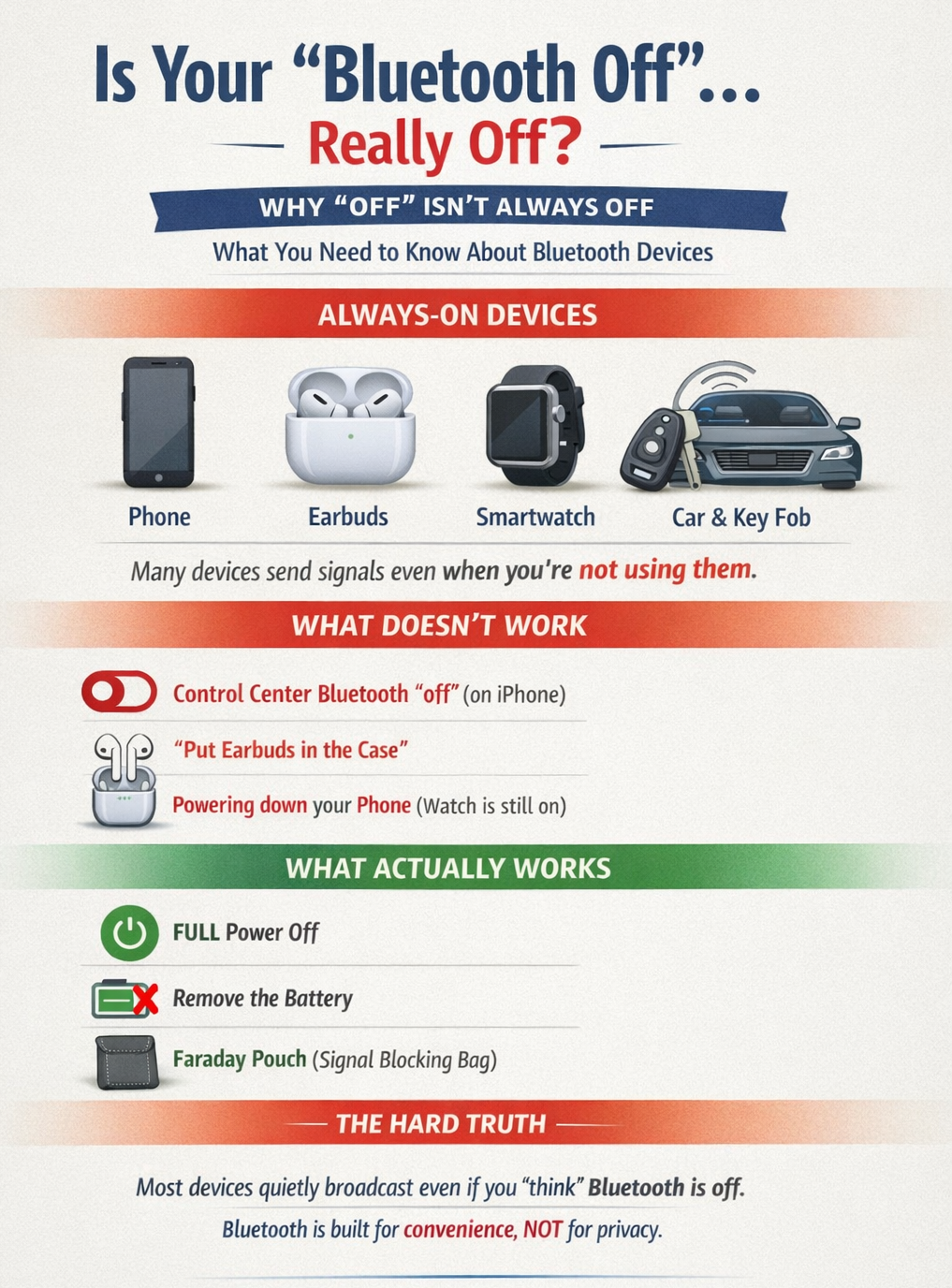
On smartphones, this problem is especially misleading. On many devices, turning Bluetooth off using quick-access controls does not fully disable it. Bluetooth may remain active for system services, location features, or connected wearables. To truly disable Bluetooth, users often need to dig into full settings menus, and even then, reboots and updates may turn it back on.
Earbuds, Cars, and Key Fobs: The Common Offenders
Wireless earbuds are a common blind spot. Most do not truly power off. Instead, they enter a low-power mode and continue broadcasting intermittently, even when placed in a closed charging case. This allows for fast pairing and instant reconnection, but it also means they remain detectable. For many models, the only reliable “off” state is a fully drained battery.
Cars and key fobs present even bigger challenges. Disabling Bluetooth on your phone does not stop your car from broadcasting its own Bluetooth identifiers. And most key fobs cannot be powered off at all. Some broadcast periodically regardless of use, while others activate based on motion.
Turning Bluetooth off is annoying. Leaving it on is effortless. And the privacy cost is largely invisible.
The Bottom Line
Bluetooth exposure persists even among people who are privacy-aware. Not because they don’t care, but because the systems are designed to make constant connectivity the default.
Bluetooth was built for convenience, not privacy. Bluetooth surveillance is not theoretical, and privacy literacy is not paranoia. In a world of always-on devices, understanding Bluetooth tracking is now an integral part of everyday life.
AI Generated Image - ChatGPT version 5.2
Ubertooth One
https://greatscottgadgets.com/ubertoothone/Bluetooth Core Specification
https://www.bluetooth.com/specifications/Apple AirTag Overview
https://www.apple.com/airtag/Android Unknown Tracker Alerts
https://support.google.com/android/answer/13658562Nordic nRF Connect
https://www.nordicsemi.com/Products/Development-tools/nRF-Connect-for-mobileLightBlue BLE Tool
https://punchthrough.com/lightblue/Wigle Wireless
https://wigle.net/BLE Privacy Overview
https://www.bluetooth.com/learn-about-bluetooth/tech-overview/Things You Should Know
https://thingsyoudidntknow.com/why-you-shouldnt-leave-your-bluetooth-always-on
Paraben Stronghold Faraday Bags
This content was developed in part using AI assistance from OpenAI’s ChatGPT (version GPT-5) and Grammarly (version 14.1268.0).